Examining the Past to Create Transcendant Futures
All books are moments in conversations between what came before and what comes after, between author and readers, between author and influences and contemporary culture, between versions of themselves. I like science fiction best when it is aware and intentional about its place in this conversation, honoring its roots while adapting and improving and taking risks about where it all goes next.
Atlas Laika's Aurethia Rising has a lot of things that normally are nos for me: young protagonists expected to save their world(s), a heavy emphasis on fighting and battle, a straight line back to Dune as an influence. I disliked the Dune books (like, a lot) and I tend to bounce right out of media influenced by them and their like.
But I also think there are a lot of places in the cis het white guy sci fi canon that desperately need some queering up, and one of the things I am most fascinated by is how stories and storytelling shift across time and space and retelling. I love epic stories with descriptive prose, vast galactic civilizations, and richly developed histories; I especially like stories that are self-aware and unapologetic about recognizing their predecessors as they push into new and different territory.
Aurethia Rising does all of this with a layered and complicated cast of characters you can't help but root for–even as they make terrible choices for the best and worst of reasons.
LZ: I have a dozen very specific questions about worldbuilding which could take up several of these chats, so I'm going to start with one of my favorite pieces: food and material goods supply, demand, and pressure points. The conflict between worlds, the cultures of the civilizations, and the depth of the setting as character all rely heavily on the reader's understanding about who controls production and availability of goods–food, medication, clothing. It is foundational to the universe and the story, offering insight and depth to characters and their conflicts. What was your process like developing this aspect of the universe?
ATLAS: Oh, what a chewy question. I love it. Also, I totally understand. The Greater Universe is huge and it's constantly expanding. There's a lot to yap about, a lot I could really dig into, planet by planet, world by world, and I still can't believe it's a playground I put together on my own - obviously with the help of the science fiction and fantasy landscape as a whole. Which is a good jumping off point for an actual answer: honestly, I just looked around.
Historically speaking, we've evolved to rely on each other for trade, education, language, faith, money-trading, etc. and that desire to learn, grow, and even conquer, given mankind's rampant colonization effort throughout history, hasn't wavered much in the grand scheme. Right now, Israel's leadership is committing genocide in the name of anti-terrorism. Realistically and historically, they're interested in ownership of both land and people. Russia has invaded Ukraine in an effort to control ripe soil and access to minerals, yet their government is propagandizing the war as an 'intervention' into a non-existent stabilization drive for a people who were very much stable to begin with. I cruise through Tribal land often enough to notice the Indigenous people’s lack of, well, everything, and I'm reminded that not too long ago, the place I've recently decided to call home was forcibly taken from somebody else during America’s colonization and eradication effort of the native population. It's a bloody, messy, shameful thing - being human. And I didn't think that would change, oh, six thousand years into the future.
To be frank, I doubt we'll make it that far, but if we do, I think Earth's history will follow us to our next home, and follow us from there, too. If money and religion are still credible and useful, then food production–healthcare, especially–and clean water would be hoarded, mandated, released, and controlled by the people with access to wealth. And in regard to religion, something I've decided to steer clear of for now in The Greater Universe, the people who controlled the church or popular faith would also dictate who was special or good enough to receive care.
Science fiction is fiction, so I took creative liberties within my universe that some might squint at. Plastic is still available and utilized. Given it's recyclable, strong, and commonly used by NASA, I doubt it'll be replaced anytime soon. I also decided to lean on cultural relevance from the Earth I currently live on, because, well, in some dreamy, romantic way, I hope art, language, poetry, storytelling, and food continue to transcend time, and that the cultures of today continue to influence the cultures of tomorrow. When I think of the far future, I still see ramen, and fufu, and braised beef, and stuffed fish, and squid ink pasta, all touched by the people and places these big homeworlds I've penned are inspired by and borrow from. What is sci-fi if it isn't in conversation with who we are today, you know?
LZ: Yes, absolutely! There are several layers of conversations in AR that question good vs. bad /right vs. wrong where you have to survive and make change happen in systems you didn't create or agree to and can't just walk out on; the characters all have to confront their own complicity and responsibility at some point. One of the POVs in Aurethia Rising is an antagonist who could easily have become a caricature; he serves as foil for one of the MCs, but because he gets his own pages, the reader gets to see his doubt and regrets and attachment and purpose along with his brutality and self importance. It's a risk, to make your villain so fully human and yet let him still be villainous. How did you decide to give him his own POV chapters? Did it shift any of the balance between the MC who have the other POV chapters?
ATLAS: Ah, Bracken. My problematic child. As I was outlining the book, I realized the dynamic between Cael and Elio, and more so, Griea and Aurethia, would've been very stale and cookie-cutter, so to speak, if I didn't give the reader a look into Cael's alternate future. If he'd continued to put his faith in his house, government, family, and this machine he'd helped build, then he would've grown into exactly who Bracken turned out to be. And to see Bracken - someone who could've put his military career to rest, played with his reindeer, farmed, and become a simple leatherworker - lean on his upbringing, ego, legacy, and other people's faith in him to live fully was an opportunity I couldn't pass up.
I wanted the reader to see, not only what made Bracken a villain in one light, and an anti-hero in another, but to also see why he did what he did. Perspective is everything, really. If it were Bracken's book, he'd be the scorned hero, and I wanted people to know that. To see it. And to feel it. Bracken has a special place in my heart, honestly. I'm excited for him to return, in a way, in Serpent Song.
LZ: Oh, excellent tease there. Serpent Song comes out later this year, yes? How much can you share about series plans? And how much planning do you do for each book?
ATLAS: It does, yes! June 2nd. I can share a bit, actually. Right now, I have Serpent Song and the third book in The Great Remaking in the pipeline. It's a little weird, but The Great Remaking is the first series in the The Greater Universe canon, which is hilarious to me, considering I only ever thought I'd write one book. But overall, The Greater Universe as a whole is... massive.
After Serpent Song, I'll be working on Heir Ascendant, the third book, and then I'll be pivoting to another space opera. I have a pretty big idea for a stand-alone set on Griea that'll introduce the next arc in the universe. I can't say much more or else I'll spoil a big plot point in Serpent Song, but it's set about twenty or so years after the end of Aurethia Rising, and will revolve around a young woman. I already have the title of the first three books in that series locked in. A lot of familiar faces, but even more new adventures, and a villain no one really saw coming - not even me.
Other than that, which is a lot, I think I'll be playing around in this universe for a long while. There's so much to do, and I have so much to say, so I'll likely go between space opera and contemporary for the foreseeable future.
As for planning: I'm a planner. Like, I write very detailed, very structured outlines, chapter by chapter, for every long-form project I start. When I was firmly planted in fanfic land, I never used to, but outlining kind of woke up that habit in me. Right now, I'm outlining Heir Ascendant, and I'm writing my first Contemporary Romance, which is being drafted from a sixteen-thousand-word outline.
LZ: I am totally fascinated by outliners and planners; I end up pantsing my first few drafts no matter how much prep I've done for them and I never actually know the end of the book until I get there–I outline as a revision tool, but mostly to track character's emotional arcs. If there was one thing I could change about my process, it's that. What's your favorite/most useful part of that process?
ATLAS: I hear you. It's a bit daunting to sit down and get everything down before actually doing any of the writing, and there's times where I've started drafting before the actual outline is complete just to get a feel for everyone. I started drafting Heir Ascendant but I'm still not done with the outline, and I also wrote a little of my stand-alone space opera just to shake off Serpent Song after I'd finished drafting that. So there's room for evolution and adaptation in the outlining process, for sure. Every book is different, and every writer is kind of waiting for the spark, I think, that'll really fuel the voice of a story.
I think the most useful part of the process is having something to fall back on. If I feel like I'm getting lost, or like something isn't working, I can look ahead at what's coming and adjust as I go without writing myself into a hole or writing myself into a wall. I added in a major plot twist to Aurethia Rising while I was drafting, but I was able to do so, because I could look ahead, see where I was going, and work the whole thing into Part Two without collapsing the plot. I actually split Serpent Song, originally titled Nexus Reaping, into two books, because as I was drafting, I realized the arc needed longer to bake, and the characters deserved more time to all come into their own.
Having that beat-by-beat outline still gave me the opportunity to work in the ending I'd already planned, and a lot of the conflict I'd already laid out and built. So Heir Ascendant, though proving challenging, isn't as much of a problem child, knowing I at least have an ending. I can build the rest using everything I've set up in Serpent Song. It's also nice to have an outline as a notebook for detail, so to speak, especially with big worlds. I can keep track of planets, moons, space stations, systems, cultural detailing, character names, etc. in each outline. It's a handy little info booklet for when I, the creator, forget something I've created.
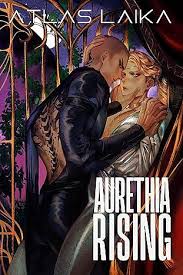
Two centuries ago, House Henly of Aurethia and House Volkov of Griea penned an engagement, promising a union between rival houses and their respective homeworlds.
Elio Henly has been preparing for marriage his entire life. As the Henly heir and future steward of Aurethia, he will inherit great power, including control of a lucrative trade route, and ownership of the most precious substance in the Greater Universe — Avara. The mysterious blue crystal native to Aurethia is the sole treatment for parsec sickness, an epidemic ravaging space travelers within the Greater Universe. But when he meets Cael Volkov, the charming heir of the outfitted military planet, Griea, everything he thought he knew about his homeworld, his family, and his heart is turned upside down.
Cael Volkov has been raised to conquer. Champion in the Tupinaire, commander of the Royal Reserve, and son to the mighty Legatus, Cael knows his mission is simple: gain the Aurethian heir’s trust, learn everything he can about the forest moon, and prepare to take it by force. But the longer he spends with Elio Henly, the quiet, brilliant Aurethian prince, the more he questions everything he was taught, and begins to push back against the rhetoric seeded in him by a lust for vengeance.