Leslie Allen: Stories Like Solar Systems
Vampire pirate captain out for revenge meets swashbuckling blacksmith princess looking for a safe place to land, sparks and blood spatter everywhere.
I met Leslie Allen when she was looking for beta readers for Sails of Black and Blood: The Revenge of Captain Vessia, and I fell in love with the book from the first pages. When I say I like my queers messy and complicated, my political fantasy deliberate and thoughtful, violence and trauma to be realistically portrayed with long-lasting, difficult repercussions and consequences...I mean like this.
It's sometimes a surprise for people when I love certain gruesome, raging, brutally violent characters so much, because my own characters (so far) tend to be gentle and kind even if they are messy in other ways. But there is a large and ragged piece of my spirit that is wholly reserved for books that feature angry, vengeful, heartbroken women, especially queer women, most especially those who fight ruthlessly to hold onto any scrap of themselves in the face of relentless, insurmountable evil.
Sails of Black and Blood: The Revenge of Captain Vessia is, at its bloody beating heart, exactly this.
LZ: MC Claire Vessia is a disaster. Beaten down by poverty and and oppression and bad luck and impossible choices with no good ends, she fights her way through to claim a pirate ship and crew–and bides her time until she can enact revenge on those who ruined her life. She's viciously violent and deeply, undeniably human. She does terrible, hateful things, sometimes for good and understandable reasons and sometimes because she's furious and impulsive and hungry. She intends to destroy the monarchy, the military, and the entire civilization that punished her for existing, and she knows that means a lot of innocent-ish deaths. She is not sorry.
Tell me about Claire, and how you balanced needing the character to be as vicious as her role and her tasks required while also having soft warm spots for readers to connect.
LA: The most strange thing about Claire is that I feel she really believes in ends justifying means. To her, all of this violence isn't hers, but instead Kitaxia's. Even her hunger. That in being robbed of the calm life of a sailor that she intended to lead, that now she's almost a mechanism of this colonial power itself, although not intentionally. That's what I really tried to write more than anything–that institutions have a level of harm that gets passed down, creating the need in which they must be resisted and in doing so, planting the seeds of their own demise. And if not her, who else?
But on the flip side, at the end of the day she is still a person with wants and needs and humanity. Captaincy and the role of resistance is a persona to her, one that she puts on every morning and takes off to sleep (when she can lol) and I'm a big believer in people having creature comforts to help them process. I gave her my love of hot drinks, the need for constant warmth, the appreciation of the sea. This is a person who seeks comfort where she can, because she knows just how rare it is.
LZ: And then there's Moira. She's steady and reasonable and competent and high on the list of Claire's targets as a member of the royal family; she has benefited from her station in ways most of the characters can only dream about, but has also been victim to its hate and oppression. Moira's role is often voice of reason and moral center–my other favorite character type–and she is as complex and headstrong as Claire is. Plus she can make swords! And fight with them! (I love her so much.) What was the trajectory of her character's development?
LA: Listen, I love me a rebel princess. It's one of my favourite tropes, but there's also a lot more to Moira then initally meets the eye with this trope.
I've always been facinated by people within systems of hirearchy that recognise that the system as designed will forever put down anyone who's different and then rebel against it.
Moira, having knowing herself to be trans for so long and experiencing the efforts of the system to put her in a very particular place, is faced with a choice. Either to accept the role as designed for her–ceasing to be the person she knows she is–or fight against that, and as a result fight against society and it's roles.
I took a lot from the realities of being trans myself and inserted that into her character. I feel like every trans person in existence comes to terms with that question, about whether to shove it all down because society isn't going to change to fit our identities, or rebel against it all in whatever way we can manage, whether that be big or small. Trans women especially get laser focused like this in society, as just by existing, society has a problem with us. That we've been given all the power men are, expected to benefit from that, and instead said no, I'd rather be myself than benefit from this system.
Moira is my rebel, my most moral character, and absolute in everything she does.
LZ: Every character, no matter how briefly on the page, has a trajectory and personal history and embedded in their circumstances and environment; this is a space where character development and worldbuilding mingle, and it's especially difficult to manage within word count limits. Do you start from a particular side on this? Do characters grow out of worldbuilding or do you extrapolate the world from the characters' lives? Or is it more of a mix?
LA: I would say that most of my characters are people that I've been writing for several projects. Dr. Maude Winters, for example, has been someone I've written into probably three manuscripts before this one. I have this backlog of characters from works I've written that will never see the light of day, but can be slotted into roles as I need them. It was easy to go from "What roles are needed on this ship, and who would I slot into them?" and then go from there.
But while I might start with a template from one of my backlog of characters, they tend to shift and adapt as I write them to fit better within the world. To continue with Maude, her marriage to Isabella came out of an inspired moment and realizing that these two caregivers were so angry at each other that it became passionate and respect for each others ability to care in their own right, even if it was through different methods.
But on the flip side, the unfortunate reality is that to keep the grand story I wanted to tell, cuts had to be made somewhere, and these same characters suffered the most from this. Maude had a whole backstory about coming onto the crew from Varcna city and her role that she held as a hospital administrator there. Each character had a moment where they got to tell so much more about themselves, but the original wordcount was something close to triple what the final cut was, and that was just too much.
LZ: All of that background work comes through what did manage to stay on the page–there's a tangible sense of each character having had an entire life outside of their appearances in Claire's story. It makes them real.
I'm curious about that process of cutting words. Where do you start, and how do you make those decisions? How do you weigh the balance of character, plot, and theme?
LA: I learned very early on in the process that not everything I want to get on the page, will get on the page. That one of the hardest bits of writing is that you have to be comfortable with cutting things that you love, because it'll make the story better for it.
But I will admit that editing isn't my best skill. I try to approach things in a very top to bottom way, constantly asking myself with each and every plot point and character moment as I read through it: does this serve the greater story? Is this really contributing in the way I want it to? Is there even a hint in this chapter that will serve the story, even if it's in the next book? I know not everyone writes like me, where I have fifty billion ideas I could shove into a story, but the best advice that's worked for me is to be ruthless in my cuts. That the ideas I do decide keeping are certainly strong enough to last in the crucible of the cutting room floor, to outlast everything else I've considered.
To me, I've always valued plot first, because I feel like characters will more than happily slot themselves into roles in service of it. Theme to me is part of plot. If you have a grand adventure of revenge, or triumph, or finding home, then theme should almost weave naturally into plot. Revenge stories are going to have questions of at what cost. Triumphs are going to have good versus evil. Found homes are going to have longing for the adventure once again. That's the beauty of writing is that even if you don't know your theme, in the story you want to tell you're going to discover it eventually.
LZ: There's an element of the writing process that requires an openness to changing your mind if you are going to be able to get the story where it needs to go. And it has to balance with what you are absolutely not willing to lose. That balance is kind of embedded in your thinking about themes, as well–revenge is seeking a price to be paid, but will also carry its own cost, you find home by leaving it, etc. And it leaves so much room to explore character's decisions and the consequences that follow. TWoCV is the first in a series–how do you manage the plan for the overall series arc while allowing for that openness and exploration?
LA: I've always felt that as long as things serve the ultimate goal, a lot can be moved around. While I think being ruthless in your cuts is a good thing, the big things, the big moments, the revelations you want to impose, the knives in the dark of ultimate betrayals, those are the moments in writing I live for. And I feel like every writer I know does too. Those are the moments and story beats that are worth holding onto no matter what. The way I imagine a book, is more like a solar system than anything else. There's these big planets of story moments that define everything around them. Gravity pulling at the characters and story to the inevitable mass of a particular action, reaction, that sort of thing.
Sails of Black and Blood as a series has always had an end that I've worked toward. From the very beginning, I knew exactly where Claire and Moira go. The ending of Revenge, and soon to be out in the world On Stranger Shores all have endings and moments that were well planned in advance. All interconnected huge black holes of gravity that everything else feels the gravity of.
But at the edges of these gravities, there's room for fleshing out of the world. Still being effected by major events, but characters having lives outside of grand consequences. Trying to get in as much of those small life pleasures as they can, living life for a moment. It will always be one of the hardest challenge of my writing, and I try my best to hint that people have lives outside of all this chaos of the world I've created, that more is happening. That there's room to wonder about a life outside of all this. Because at the end of it all, gravity will have it's due.
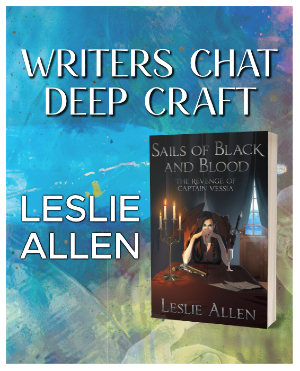
Claire Vessia’s been sentenced to death.
The last survivor of a ship of would-be-pirates captured by the navy, she’s been accused of all of their crimes. She will die for it.
Determined to go out with her head held high, her plans for a stoic execution are thrown out the window when a highborn noble lady offers her a chance to escape the noose… if she pays in vials of her own blood. But she is betrayed.